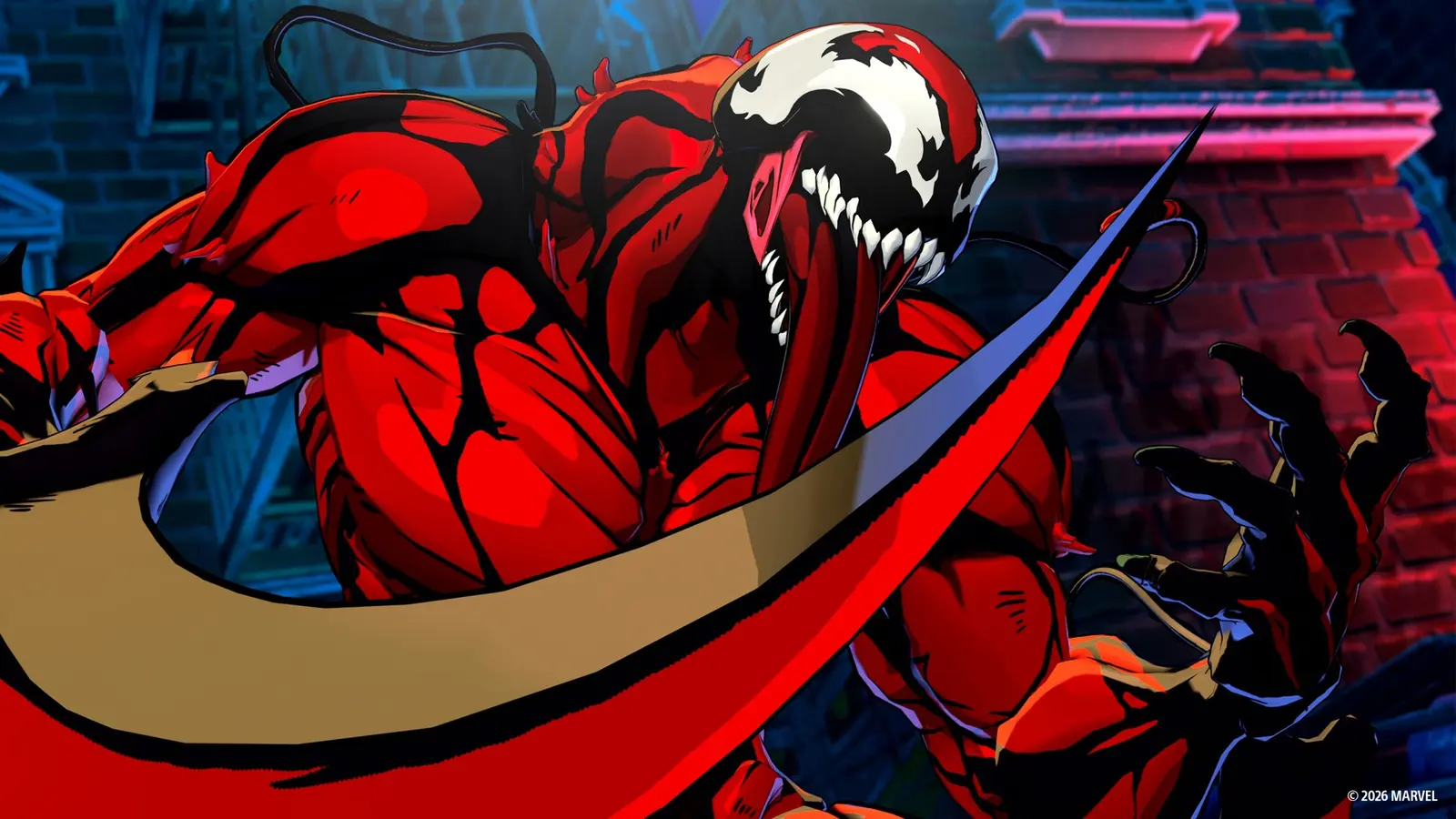
Four superheroes, one health bar and enough explosions to make your television question its life choices. Marvel Tōkon: Fighting Souls takes Marvel into anime-fighter territory, and the results are spectacular.
Marvel has had a fairly good run with games recently. Spider-Man was excellent, Guardians of the Galaxy was surprisingly good, and even Marvel Rivals managed to prove that superheroes can survive being shoved into another multiplayer game without immediately requiring an intervention.
Fighting games, however, are a different beast. Marvel also has the rather inconvenient problem of having Marvel vs. Capcom lurking in the background. Mention Marvel and fighting games in the same sentence and someone, somewhere, will immediately start talking about Marvel vs. Capcom 2.
Marvel Tōkon: Fighting Souls wisely doesn't try to recreate it. Instead, developer Arc System Works has looked at Marvel, presumably decided there weren't enough explosions, and turned everything into an anime.
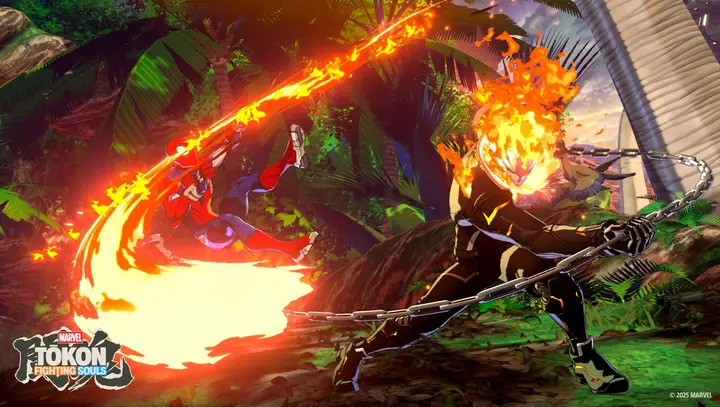
Arc System Works is responsible for Guilty Gear and Dragon Ball FighterZ, and its fingerprints are all over Tōkon. The game is colourful, fast, beautifully animated and gloriously excessive. Characters fly across the screen, assists arrive from seemingly nowhere, special attacks fill the television with effects and occasionally there is so much happening that I have absolutely no idea what I am looking at. I mean that as a compliment.
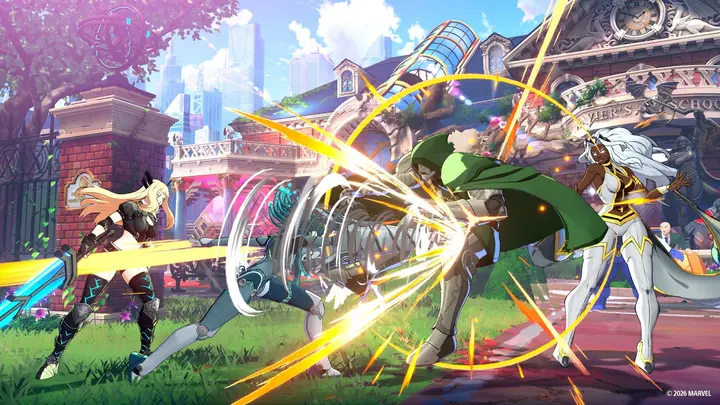
The big idea here is four-on-four fighting. Tōkon launched with 20 playable characters divided across five teams, ranging from obvious Marvel royalty such as Spider-Man, Wolverine, Iron Man and Storm to characters including Magik, Peni Parker, Danger, Robbie Reyes' Ghost Rider and Carnage.
This isn't a game where you are permanently swapping among four superheroes like some sort of caffeinated octopus. Your team shares a health bar and the game gradually brings more members of your squad into play as a match progresses. Other characters can be called in as assists and eventually become part of increasingly elaborate combinations. It sounds chaotic, and visually it certainly can be, but mechanically it makes a surprising amount of sense once you start playing.
Initially, I picked characters using the highly scientific process of choosing superheroes I liked. Spider-Man? Obviously. Wolverine? Put him in. Someone who might actually complement the other two? We will worry about that later.
After a few fights, however, you realise that choosing four characters isn't simply about assembling your personal Avengers. The way their attacks interact becomes extremely important. An assist can extend a combo, cover a weakness, interrupt an opponent or give you enough time to start another attack. Suddenly team selection becomes almost as interesting as learning an individual fighter. That is where Tōkon starts showing its teeth.
The clever part is that you can enjoy all this without first having to memorise a telephone directory filled with quarter circles and button combinations. Arc System Works has made Tōkon extremely approachable. There are simplified inputs for players who just want superheroes to do impressive superhero things, while traditional fighting-game inputs remain available for people who have spent the last 20 years developing disturbing levels of thumb dexterity.
Within a few minutes, almost anyone can pick up a controller and make something spectacular happen. I appreciate this. There are fighting games where the tutorial makes me feel like I have accidentally signed up for an evening course. Tōkon gets you fighting quickly enough that even people who don't regularly play the genre can have fun.
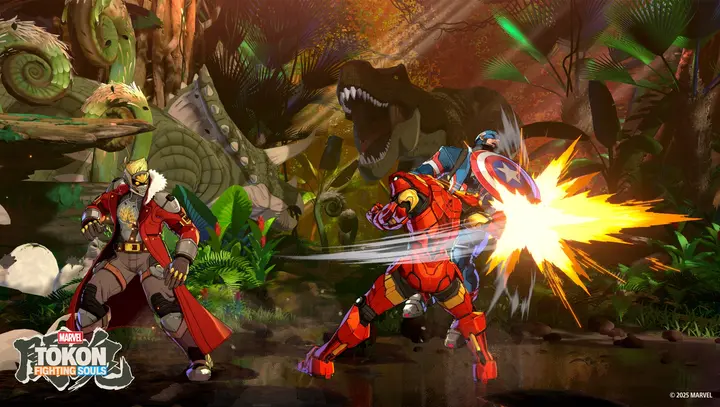
Unfortunately, this confidence lasts until you meet someone who actually knows what they are doing. There is an enormous difference between knowing how to make Wolverine attack somebody and knowing how to build an entire four-person team around Wolverine attacking somebody. Once players start chaining assists, counters and supers while switching the rhythm of their attacks, Tōkon becomes considerably more complicated.
The controls might be beginner-friendly, but the game underneath them is not shallow. That combination is probably its greatest achievement. A casual player can sit down and have fun almost immediately, while someone willing to spend weeks experimenting with team combinations can disappear down an impressively deep rabbit hole.
Then there are the graphics. Tōkon may be one of the best-looking Marvel games I have played, though it achieves this by completely ignoring the temptation to make everyone look like their movie counterparts. Instead, Arc System Works has reinterpreted the characters. The result looks like the entire Marvel universe accidentally wandered into an anime convention and decided to stay.
Characters remain immediately recognisable, but almost everything about them has been exaggerated. Wolverine looks like anger somehow developed claws. Iron Man looks wonderfully mechanical. Spider-Man moves around the screen as though gravity is merely a suggestion.
The animation is where things become ridiculous. Arc System Works has become extremely good at making 3D characters look like hand-drawn animation, and Tōkon pushes that trick hard. Ordinary attacks already look great, but some supers change camera angles and briefly turn the fight into what feels like a tiny animated Marvel sequence.
Even after several hours, I would occasionally forget I was supposed to be defending myself because something spectacular was happening on screen. This is not an effective competitive strategy.
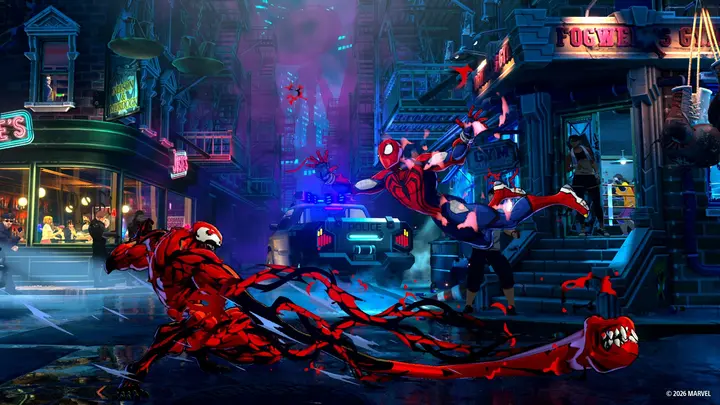
The stages receive similar treatment. There are familiar Marvel locations scattered with references for fans, and fights can burst through into different sections of the environment. The transitions aren't simply cosmetic; they help make a match feel like an actual superhero battle rather than two extremely colourful people hitting each other in front of expensive wallpaper.
The fighting is obviously the main attraction, but there is a decent amount to do when you aren't interested in being publicly humiliated online. Episode Mode handles the story using a combination of American comic-book and Japanese manga presentation, complete with full voice acting.
Rather than attempting a gigantic cinematic campaign, it uses motion-comic-style sequences to tell stories around the game's various teams. I wouldn't buy Tōkon purely for the story, but it serves an important purpose: it encourages you to play with characters you might otherwise ignore.
There is also All-Star Arena, which gives you branching paths through a series of battles, along with Survival, training options, character lessons and combo challenges. For anyone actually planning to become good at Tōkon rather than simply shouting while pressing buttons, those training tools are extremely useful.
Then there is Arcadia Rumble, the oddball of the collection. Instead of immediately throwing superheroes at each other, it uses the game's little lobby avatars in party-style rounds where you collect power-ups and eventually head into fights. It is a strange addition to a fighting game, but it does provide something different when you need a break from serious matches.
Online, there are ranked and casual matches as you would expect, and PS5 and PC players can fight each other thanks to cross-play support. Personally, though, I still had the most fun locally.
Tōkon is an excellent game to have running when friends are around. The basic controls mean you don't have to spend half an hour explaining the game before someone can participate. Hand over a controller and within minutes they will probably be launching superheroes into the air and triggering attacks that look far more impressive than the amount of skill involved would suggest.
Fighting games have increasingly become competitive platforms designed around players willing to study frame data, match-ups and combo optimisation. There is nothing wrong with that, but sometimes you want a game where your friend can come over, pick Spider-Man because Spider-Man is cool and immediately start causing trouble.
Tōkon manages both. Someone can button-mash their way through an entertaining evening, while experienced players can spend a ridiculous amount of time figuring out team composition and assist timing. That makes it one of those increasingly rare games that is almost as entertaining to watch as it is to play.
The most impressive thing about Marvel Tōkon: Fighting Souls is that it doesn't feel like Marvel vs. Capcom with different graphics. Arc System Works has managed to build something that has its own identity.
The four-character system initially sounds excessive but gives team building real strategic importance. The simplified controls make it accessible without removing the depth fighting-game fans expect. The 20-character launch roster provides plenty of combinations to experiment with, and the presentation may be the best marriage of Marvel and anime we have seen in a game.
More importantly, Tōkon understands something very simple that technically brilliant games occasionally forget. It is fun. It is fun when you know exactly what you are doing. It is also fun when you have absolutely no idea what you are doing but Spider-Man has just flown across the screen, Wolverine has appeared from nowhere and half the stage has exploded. That counts for quite a lot.
Marvel vs. Capcom fans shouldn't expect a replacement for their beloved series because this isn't trying to be one. Tōkon is Arc System Works taking the Marvel toy box, tipping everything onto the floor and building something of its own. And somehow, amongst all the assists, supers, explosions and flying superheroes, it works.
- Approachable controls with real depth underneath
- Excellent four-character team system
- Spectacular animation and presentation
- Great local multiplayer
- Visual effects can become difficult to follow
- Online play exposes a steep skill gap